
I’m afraid I didn’t take many photos today. I’m very conscious not to treat people as exhibits in a travelogue. Just because someone looks different or has a different life, I don’t want to objectify them in photos to show off ‘back home’. This is my personal anxiety and I know other people feel differently which I totally respect.
Elephant Song – Sesfontein – Warmquelle – Okondono – Elephant Song
There are bat eared foxes at Elephant Song. I saw their tracks near Magnus’s room a few days previously. He said there were two who visited. I was pretty certain he fed them, because each day I saw fresh prints around his room. But in the night I heard a noise and looked out the tent window. I saw it come out from our shower. It was small but had huge ears (obviously). It was gorgeous. I love our UK foxes, but these were prettier still.
Today we went in search of vegetable again – everything in Africa is an adventure.
We failed to get vegetables the first time we were in Sesfontein, but we had been told that further down the main road (actually a gravel road) there was a ‘gardener’. We hadn’t wanted to go further on that day, and started to rely on canned pulses and vegetables instead (we’re vegetarians). When we told Magnus we were short of vegetables, he offered us one of the two carrots he had grown in his garden back home. I was amazed at his generosity, when he had so little. I have often found that those who have the least, are the most generous.
We decided to try and track down the ‘gardener’.

The mornings drive to Sesfontein was through the desert plains and beautiful. At Sesfontein we were told the ‘gardener’ was a 40 minute drive away. We tried to get some more diesel, but found that the petrol station had run out of fuel. The road was washed away in a flash flood two weeks ago, and the tankers couldn’t get through. The Land Cruiser was equipped with two fuel tanks and we had enough for the time being, but it wouldn’t be long before it ran out.
There was a little settlement and junior school 40 minutes down the road from Sesfontein. There were lots of people around a bar who directed us to the ‘gardener’. What an inspiration he was.

Louie, the ‘gardener’, was a Namibian farmer who had sold his large crop farm in the agricultural area of the country, to create a big farm in the desert. When locals usually talk of farms they mean a tin shack with a few goats, but this was a real farm. It had been used by the South African Defence Forces (SADF) to feed their troops during the Namibia independence war. It had decayed when the war finished, until Louie took it over. He had made his money with his large farm in the east of the country, and now wanted to raise the standard of living for people in this very poor area. He agreed with the government to take over the remnants of the SADF farm and try to inject prosperity into the area.
Louie used solar pumps to pump water out of the nearby hills. Strangely, there is quite a lot of underground water in Namibia, it just requires investment to access it. The population is so small it isn’t always economically viable to pump the water from the underground aquifers.
Louie had large fields of squashes, and huge greenhouses for tomatoes and peppers. Unlike Europe, the greenhouses were opaque to shield from the sun, but were mainly used to protect from pests. He only sold seasonal crops, and we came away with 3kg of red and green tomatoes (which tasted better than any tomatoes I’ve ever tasted!) and some peppers.
Louie was amazing and such an inspiration. He had spent some time farming in South Africa and had been attacked on his farm, which galvanised him to move back to Namibia. He showed us the physical scar, but he spoke so kindly about the people he was trying to help, that there was no sign of the kind of racism I would expect from someone who had been attacked like this.
The farm employed many local people, and he also had brought with him a few of his trusted staff from his previous farm. When he left us for a bit, we spoke to them, and they all had lovely things to say about Louie.
Louie gave some of his produce to the locals in need, and went into the schools to educate them in his farming techniques. Although, he did talk of his sons (who were currently in America) taking over the farm when he got too old. His wife wasn’t keen on the area, and stayed in Swakopmund most of the time. He repeatedly talked about trying to elevate the standard of living in the area. We spent some time talking with him and he went from treating us as standard to tourists, to inviting us for a Braai one evening. That was very flattering.
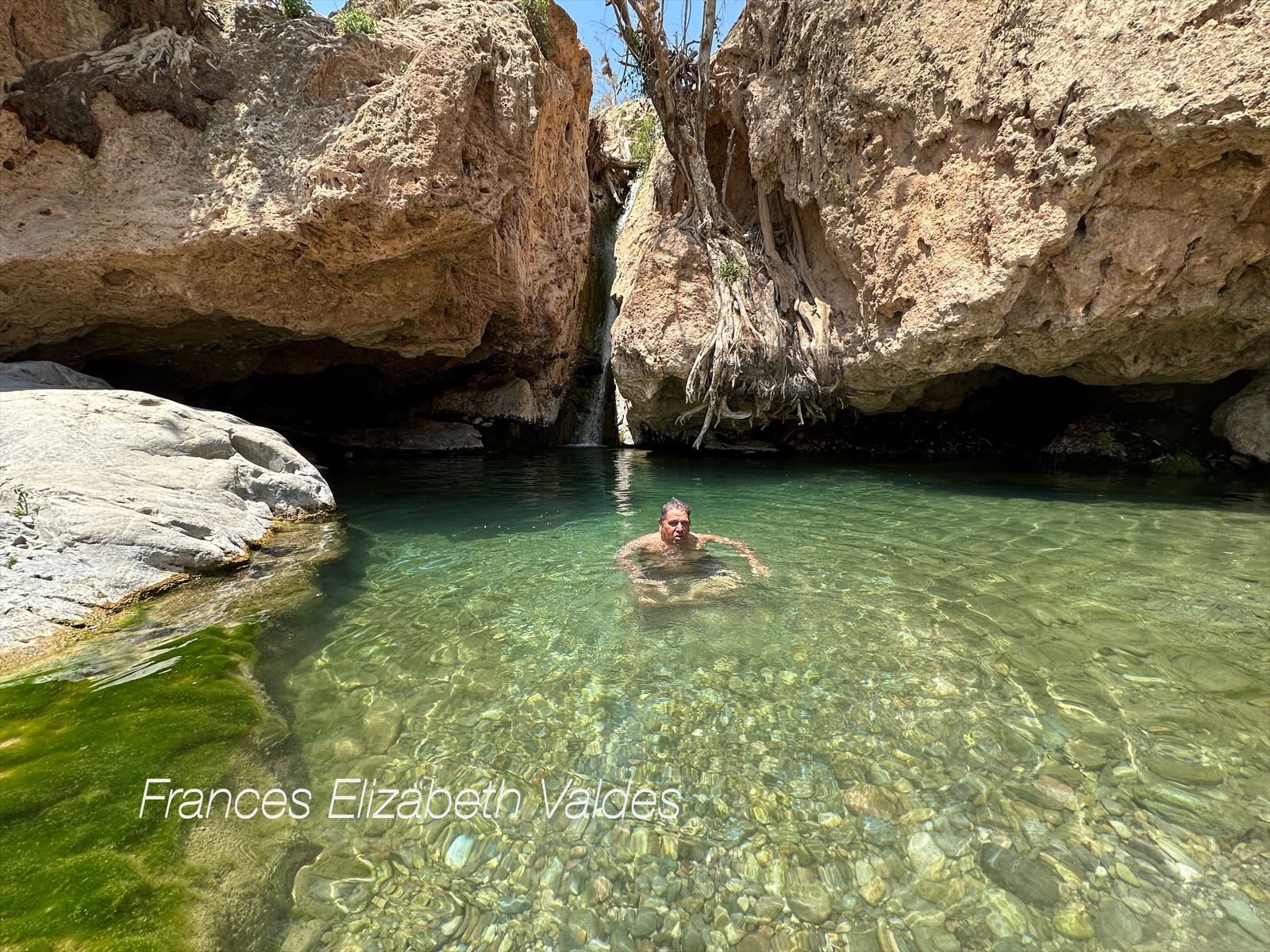
We left Louie and went a little further to a waterfall in the desert. We had been here in 2019, when we were staying in a nearby lodge. It had seemed very out of place in the desert. The water came from an aquifers in the mountains a little further away, and exited into the open here. It was an entirely natural waterfall in one of the driest deserts in the world. The water was beautifully clear and we had a swim.
When we stayed in the area before, it was littered with bare looking shacks. Now, those shacks looked entirely different. The shacks near the farm were fenced with gardens growing healthy looking maize, tomatoes and even bougainvillaea. The shacks had not just tapped into the water supply Louie had brought to his farm, but had clearly actually learnt how to use the water to create small scale crops. This was clear evidence that what Louie was hoping to do, was working.
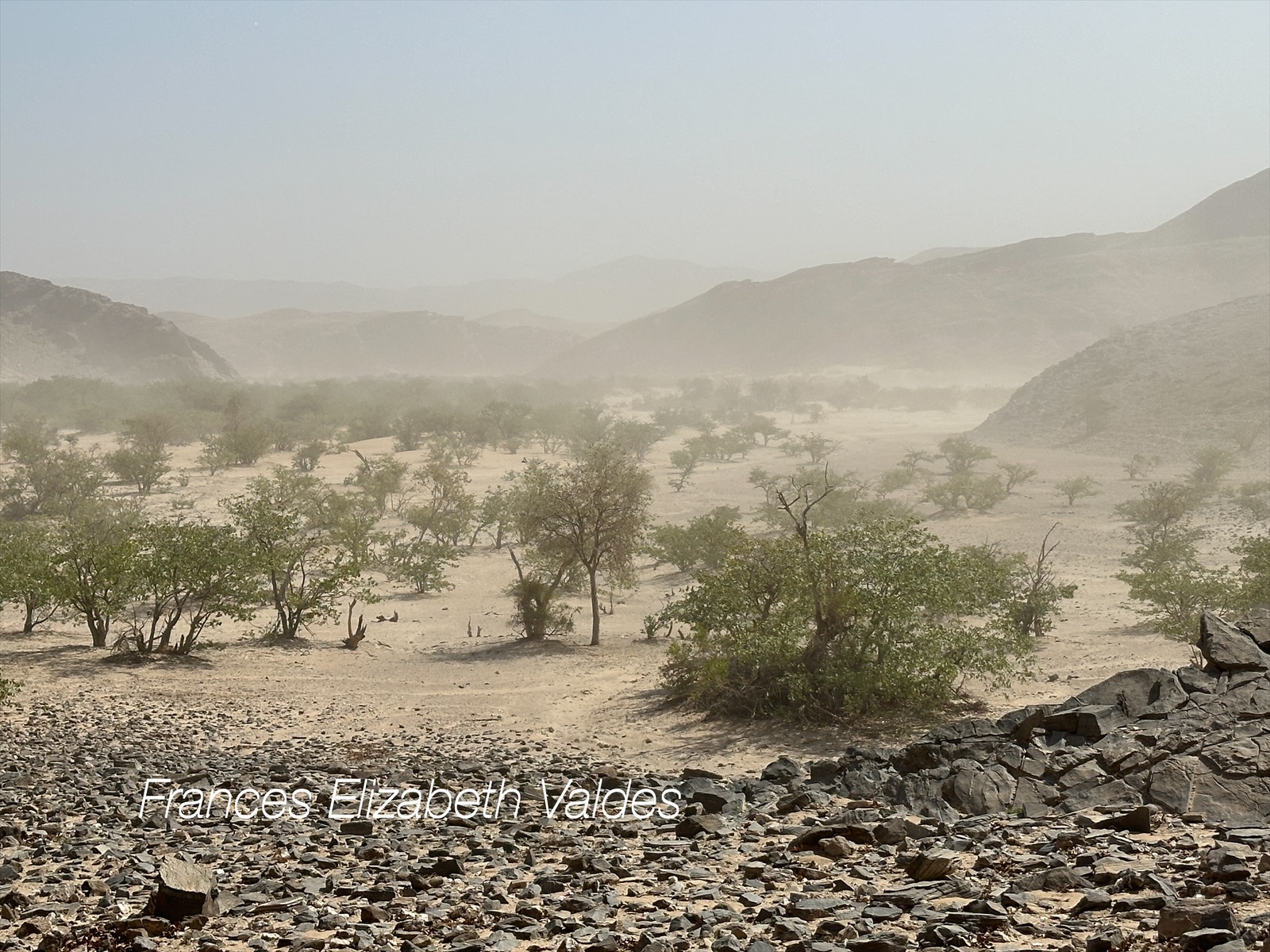
It was mid afternoon when we turned off the Purros road on to the plains leading to the Hoanib valley. It felt like coming home. However, a major sandstorm had blown up. Our tracks out of the Hoanib had been completely covered. There were many tracks to follow in the Okambonde Plains, but only one led us directly back to Elephant Song. Luckily, Nigel had been experimenting with an app which had tracked us out of the plains, and we could use it to track us back.
We had brought shopping back for both the conservancy gate keeper, and Magnus. The gatekeeper, like Magnus, was posted in the desert for six weeks at a time. When we left the conservancy that morning we asked him what he wanted. Like Magnus, when we said we were paying, his needs included luxuries like deodorant and Coca Cola. But, despite us saying we would pay, he didn’t ask for much. Like Magnus he craved meat.
When we were shopping at Sesfontein someone came up to us and said can you bring the conservancy guy these tablets. He hadn’t asked us who we were, or if we were shopping for the conservancy guy, he just handed us the tablets. We had no idea how they knew they were needed. It turned out that, if you held your phone in the air at a certain point in the conservancy compound, you could just about get a phone signal. He had contacted his friend in Sesfontein, and since we were the only white people in the town, they knew to hand them to us!
Nigel cooked mashed potatoes, ‘beef’ flavoured soya mince, with Louie’s peppers, and tinned vegetables – it was delicious in a camping way. That is to say, it would not have been good if we were at home. Camping makes things much more delicious.
Soya mince is readily available here. Sadly it isn’t because people are vegetarian by choice, it’s all they can afford!
We watched the sand storm from our camp, as it swirled in the plains below. I began to worry about whether we would be able to put the tent on the Land Cruiser up, as it was so windy. It was too windy for a campfire. I miss campfires.

 Desert Wonderers