Mudorib – Hoanib – Mudorib
Mornings wild camping are so wonderful. There’s something about waking up and being totally alone in the wilderness – a feeling of total freedom, of excitement in what the day ahead holds. There is no pressure; no time schedule of when breakfast can be taken, of leaving the room in time for the maid to make up the bed, of making sure you are back in time for dinner.
We went to the Presidents Waterhole first to see if there was any interesting fresh spore. Sure enough, it looked like ellies had been in the night. They were heading further west towards the Skeleton Coast. We hadn’t been to that end of the Hoanib much. It wasn’t possible to go too far as entering the Skeleton Coast park at that point was prohibited.
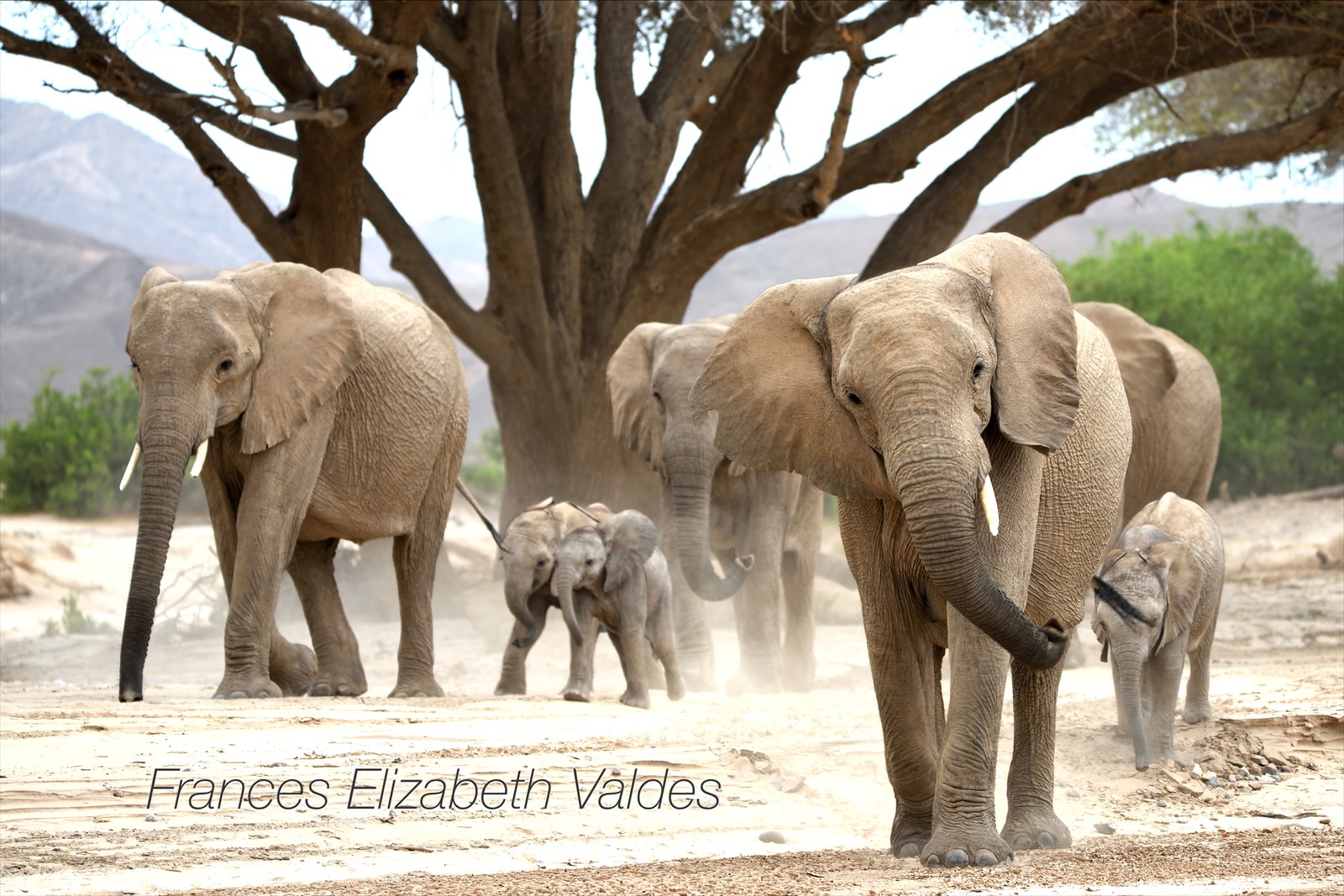
It didn’t take us too long to find the elephants. They move reasonably fast in the morning. Later on in the day they slowed, often eating or sheltering from the sun with the babies asleep. We followed them at a distance. So beautiful. I could spend hours looking at them.

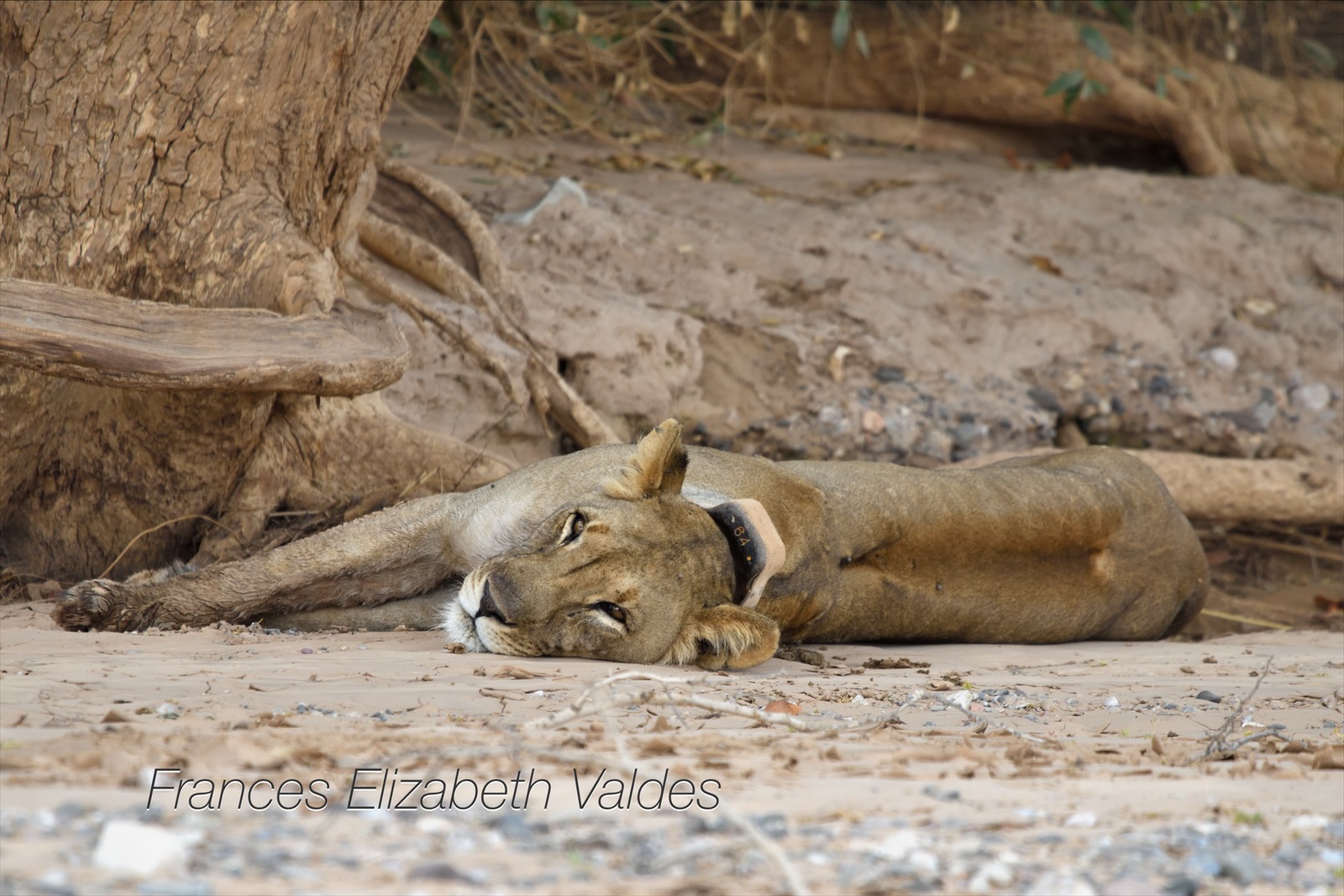
Mid morning the elephants and us had stopped, when I noticed something under a tree. It looked like a large dog. At first I wondered if it was a hyena, and then I realised it was a lion. We moved closer and watched it, but like all cats it just slept. It had a radio collar but was by itself.
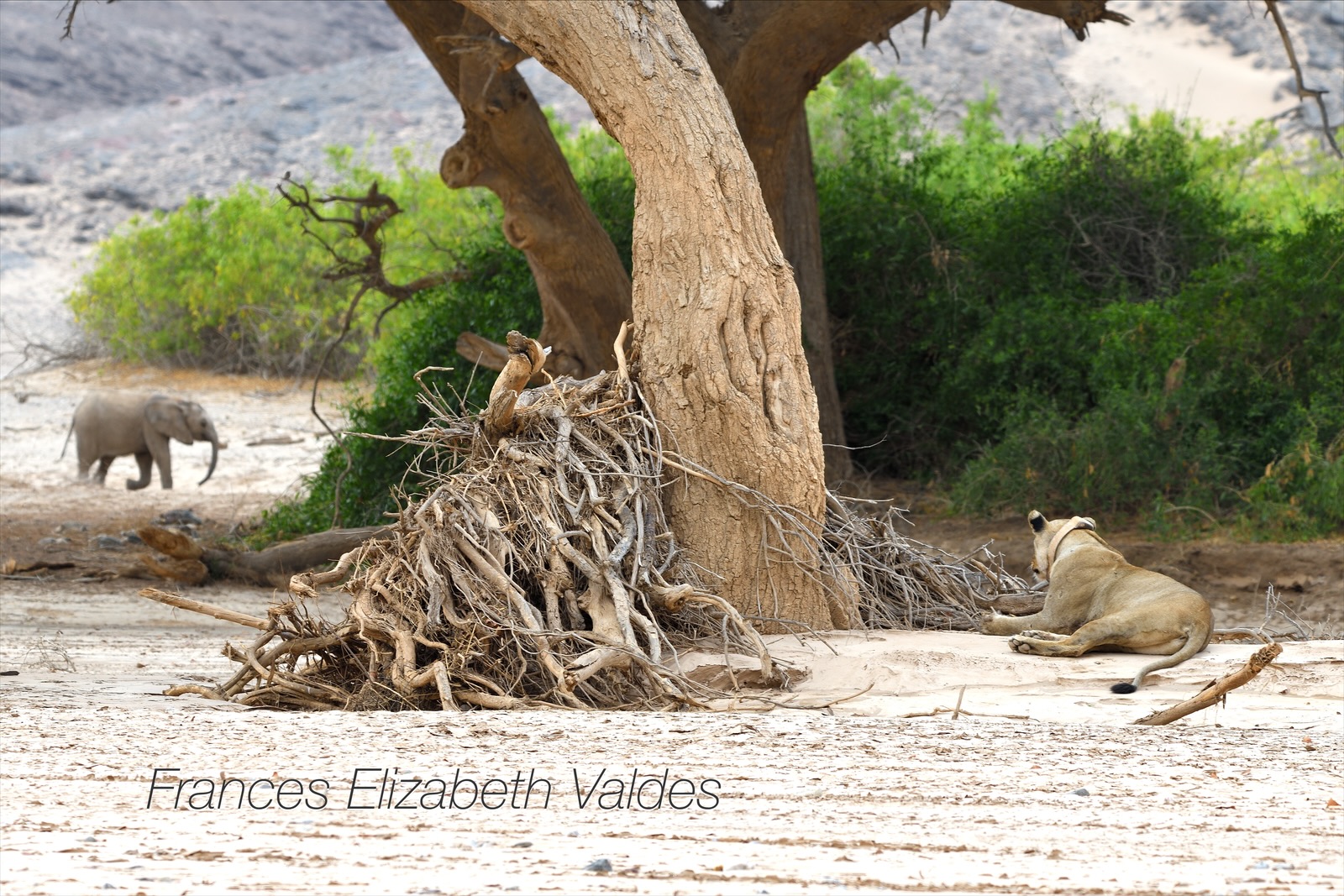
The lion ignored the adult elephants but was very interested when the young baby walked by. I don’t think the elephants could have seen it under a tree, as they were on the other side of the valley.

We noticed saw the car belonging to last night’s campers further ahead, taking photos of the elephants but out of their car. We rushed over to them to tell them we didn’t think it was safe, as there was a lion just over by the tree. I guess it’s arrogance on our part, to imagine they didn’t know what they were doing. They weren’t overly fussed about the lion.
We discovered the German man had been coming to Namibia for years. He was totally in love with Africa, and had been coming to the Hoanib for at least 20 years. His particular passion was lions. The young German woman was here for the second time. Over the next couple days we kept meeting them, and they were really nice and interesting. They told us that there was a pair of lionesses, and a male lion in the area. They were looking for the male lion. They had seen the bull elephant yesterday and watched as he met with the ellie family we were following. He was bigger than the other elephants, and had reached up into the camel thorn tree to shake down the pods for the family – such co-operation and consideration.
The elephants had moved on, and we had got bored with the lion who was still asleep, so we drove on following the elephants. We intended to end up in Purros the next day (camping overnight on the way). In 2020 we had gone to Purros, but we wanted to take a different route this year. Yet again we had been told that we may not get there because the river had flooded recently, but we decided to risk it. We were not always being given up to date information. Our intended route took us along the edge of the Skeleton Coast National Park. Handily, the elephants were taking us in that direction.
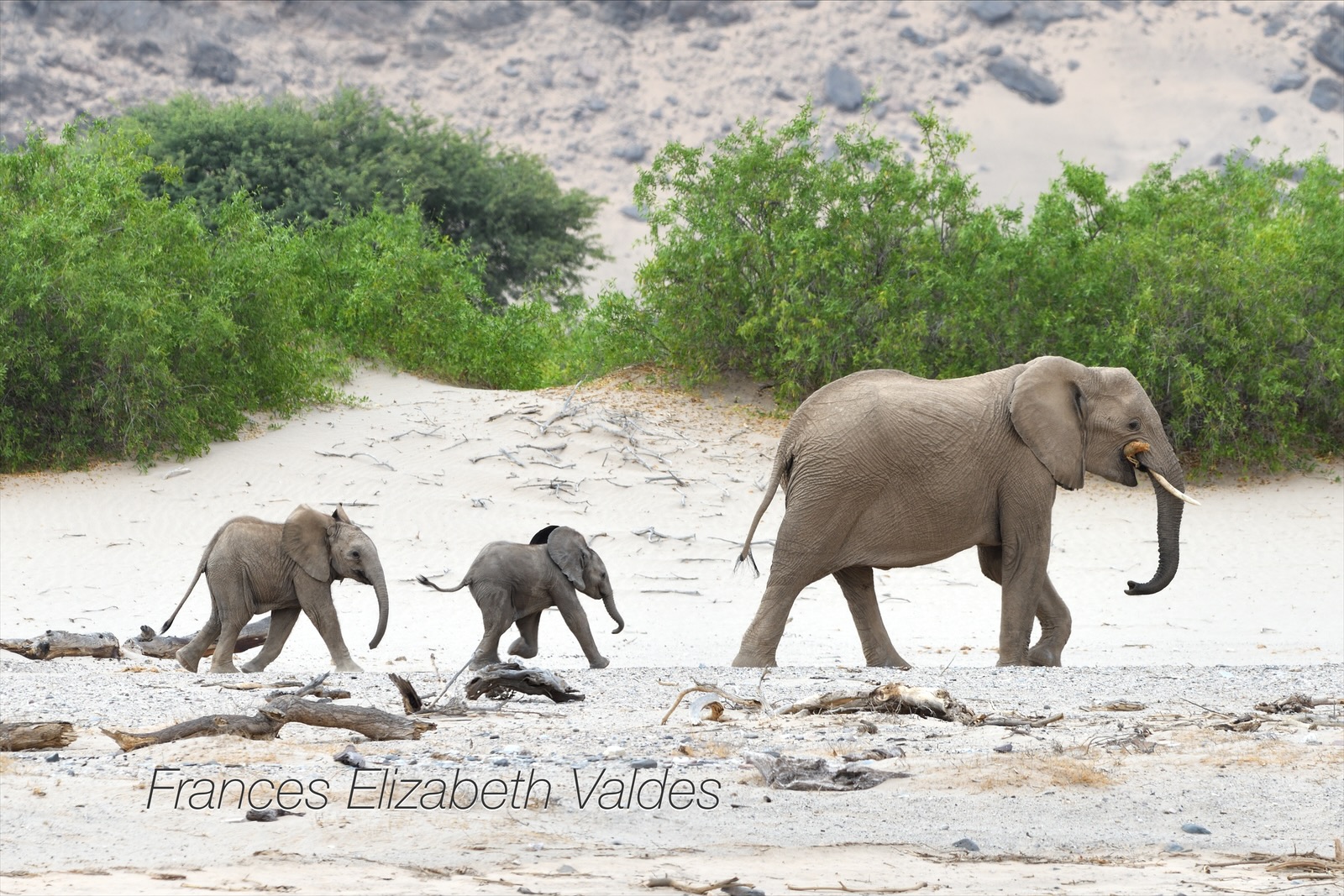
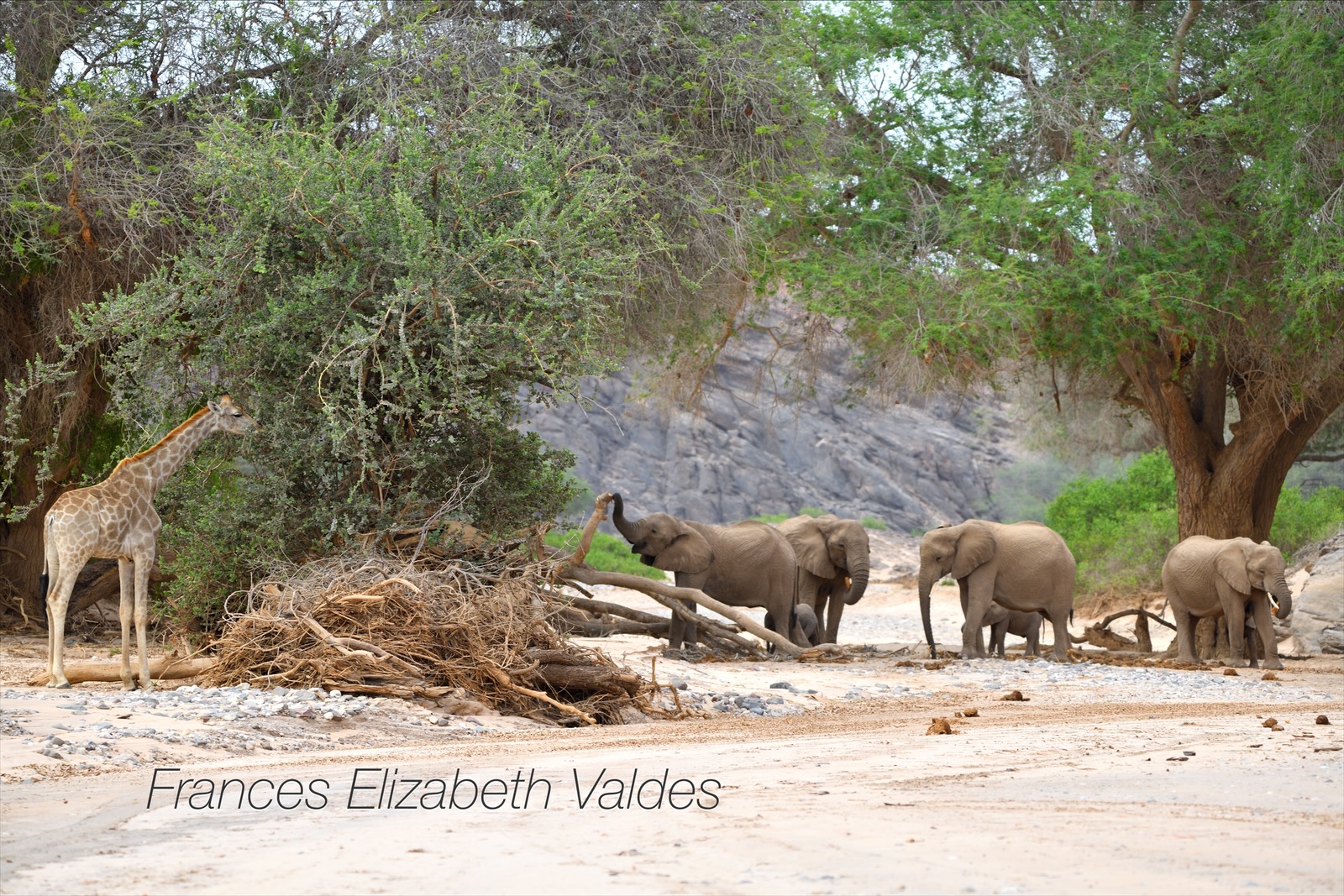
We had lunch at a lovely wide sandy area. The landscape was different from the east part of the river valley. It was no longer cocooned by dark mountains, and was much sandier. It hinted of the Skeleton coast beyond, although the dunes was some way off
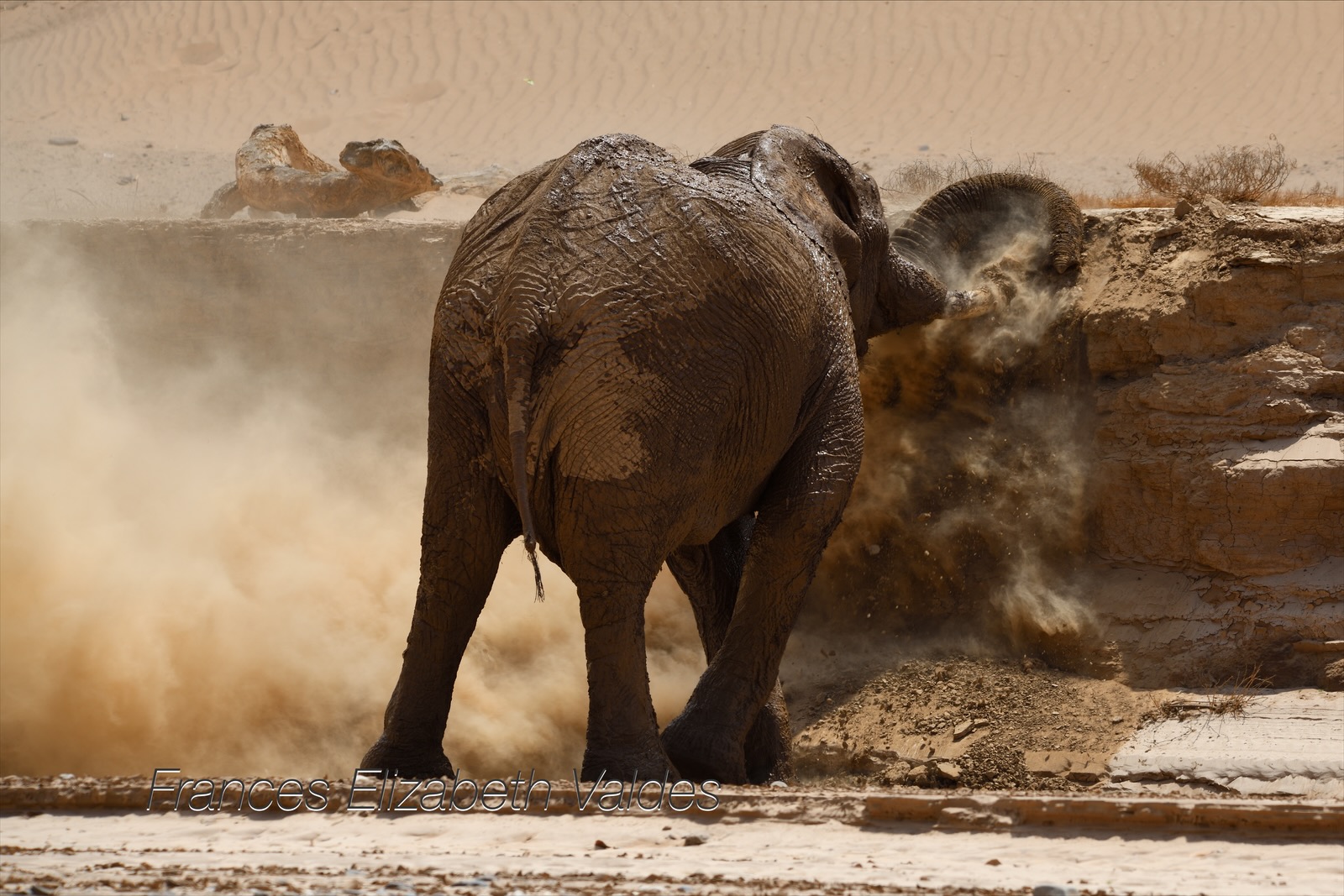
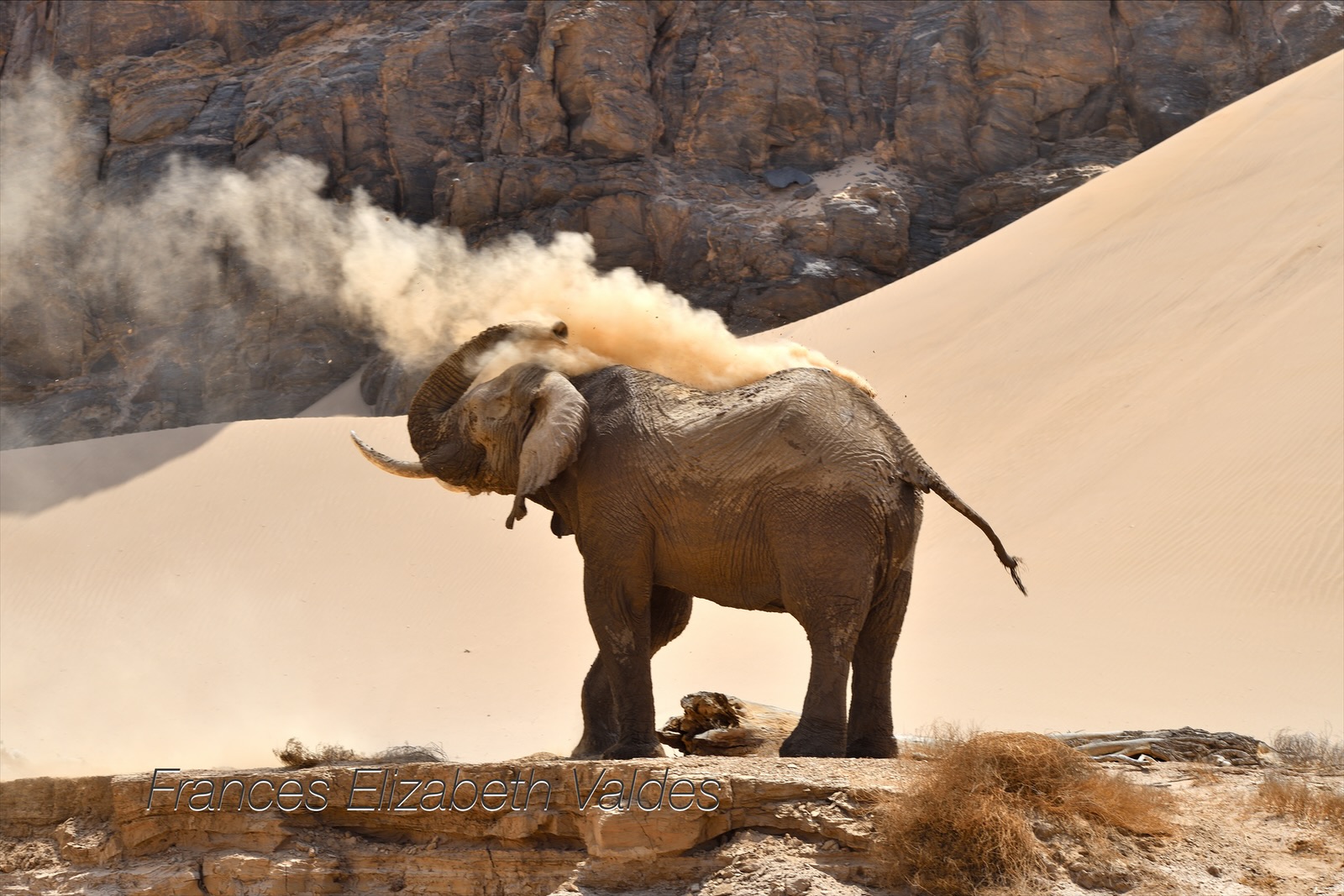
I think it was after lunch we came across the bull having a bath in a small puddle of water, at the base of a rockface. the water was in a deep hollow which looked as if the elephants had dug. After his bath he went to the sandy edge of a terrace just by the waterhole, and used his tusks to dig out the sand and spray it over himself. It showed such power and strength, but also premeditation, and calculation. Elephants are such amazing creatures.
We followed the Hoanib further, to get to the track we needed to take for Purros. In the distance, I saw an unmistakable lion tail. We got closer, and framed in the crook of the tree was a beautiful male lion. We were aware that the Germans had very much wanted to find the male lion, so we rushed back to find them.
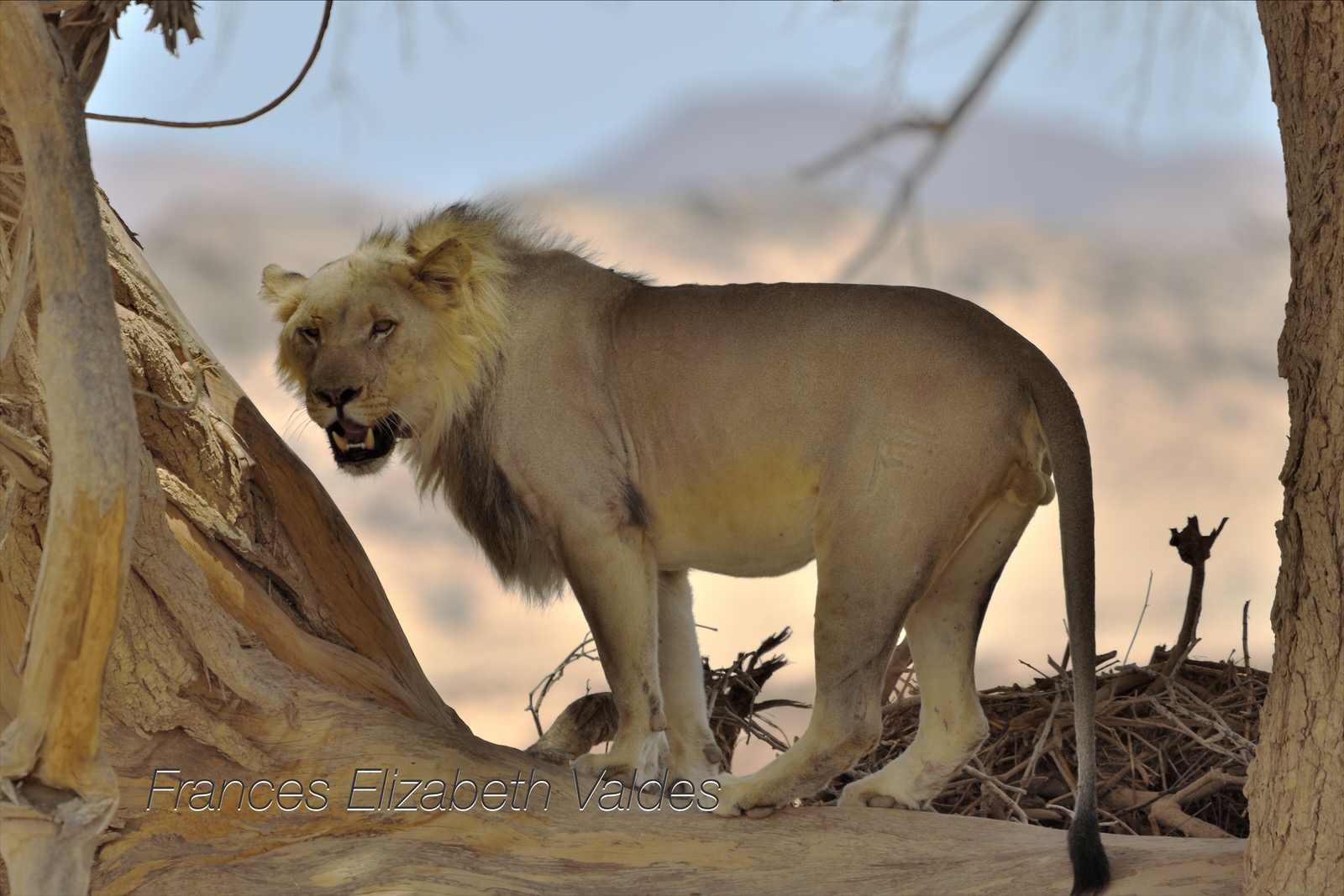
We found the Germans around 10 minutes away under a tree, having a picnic. They packed up and followed us, but of course the lion had gone. We followed his tracks up to a raised sandy terrace. We left the Germans looking for him, and returned to driving west.
At some point, I’m not sure when, we came across a lodge vehicle with the occupants sitting around an immaculately laid table. Nigel stopped to tell them where the lion was, but the lunch eaters couldn’t hear him. Then one, albeit elderly lady, got up and said I suppose I will have to come over to you. Nigel shouted again saying there were lions to be seen, and did they want him to tell their driver where. They agreed and went back to their food and wine, which they appeared more interested in. I guess people come to Namibia for different reasons, and with different interests.
We drove as far as we could go in the permitted Hoanib, and turned off to head towards Purros. This was a well defined, and clearly well used wide track. But the corrugations were terrible. The tracks were wide, clearly because everyone drove either side of corrugations to avoid them, and in doing so made new ones. The valley was wide enough to accommodate an ever expanding road. We rattled along the corrugations for a couple of hours. We were half looking for a sheltered campsite, although it was rather early to stop.

We turned off the track and went up a side valley climbing a hill at the end, for a view of the surrounding area. It was magnificent, giving an expansive view of the Skeleton coast, and the lower part of the Hoanib. The Hoanib was marked by a line of vegetation. The view was over the prohibited area, and we later discovered there was a large herd of elephants in it
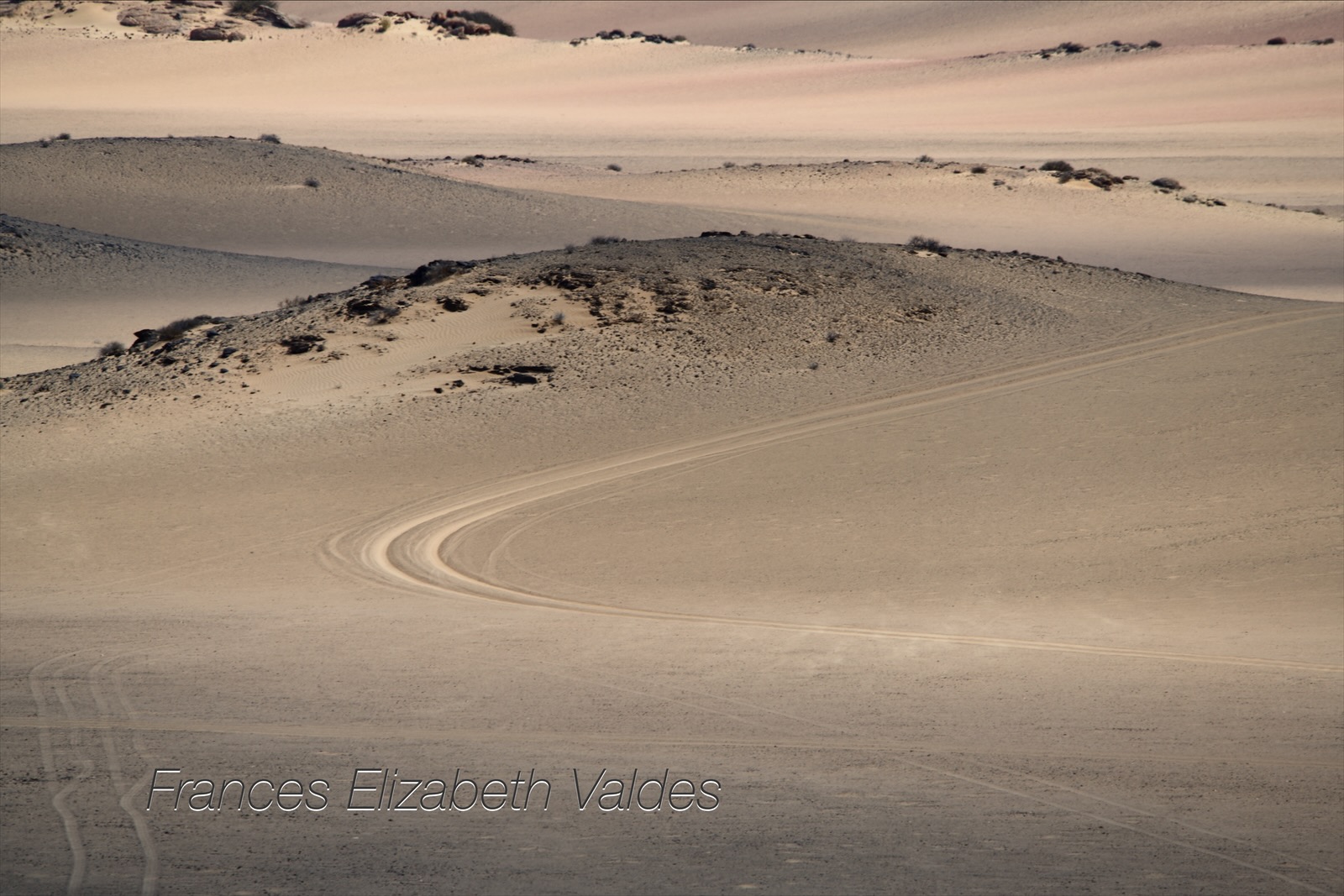
Neither of us were enjoying the drive on the washboard surface, and it was clear the track went on like this for a really long time. I was puzzled as to why the road was so well used, in an area of such little tourism, but could only assume that the few luxury camps used this road to get to and from an airstrip at Purros.
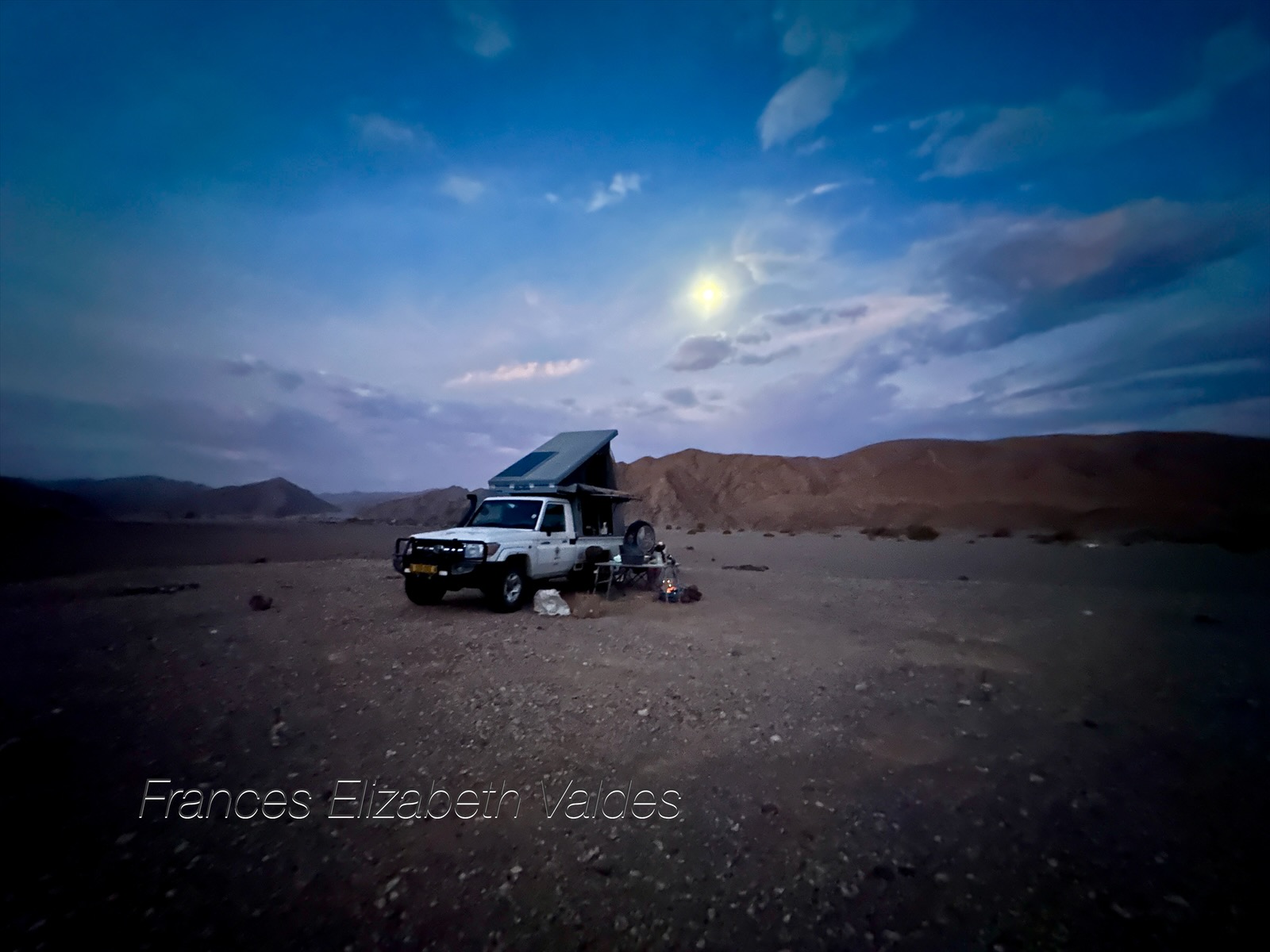
In the end the corrugations got to us, and we turned back. Nigel was hoping to find a campsite sheltered from the wind, but we failed and ended up back at our usual Mudorib camp, sheltering behind the land cruiser. I was getting quite adept at bread making at this point, so I needed a fire which I think we eventually managed to keep going.
As it got dark we saw the German couple arrive, and camp in the same spot as yesterday, some distance in front of where we were.
 Desert Wonderers