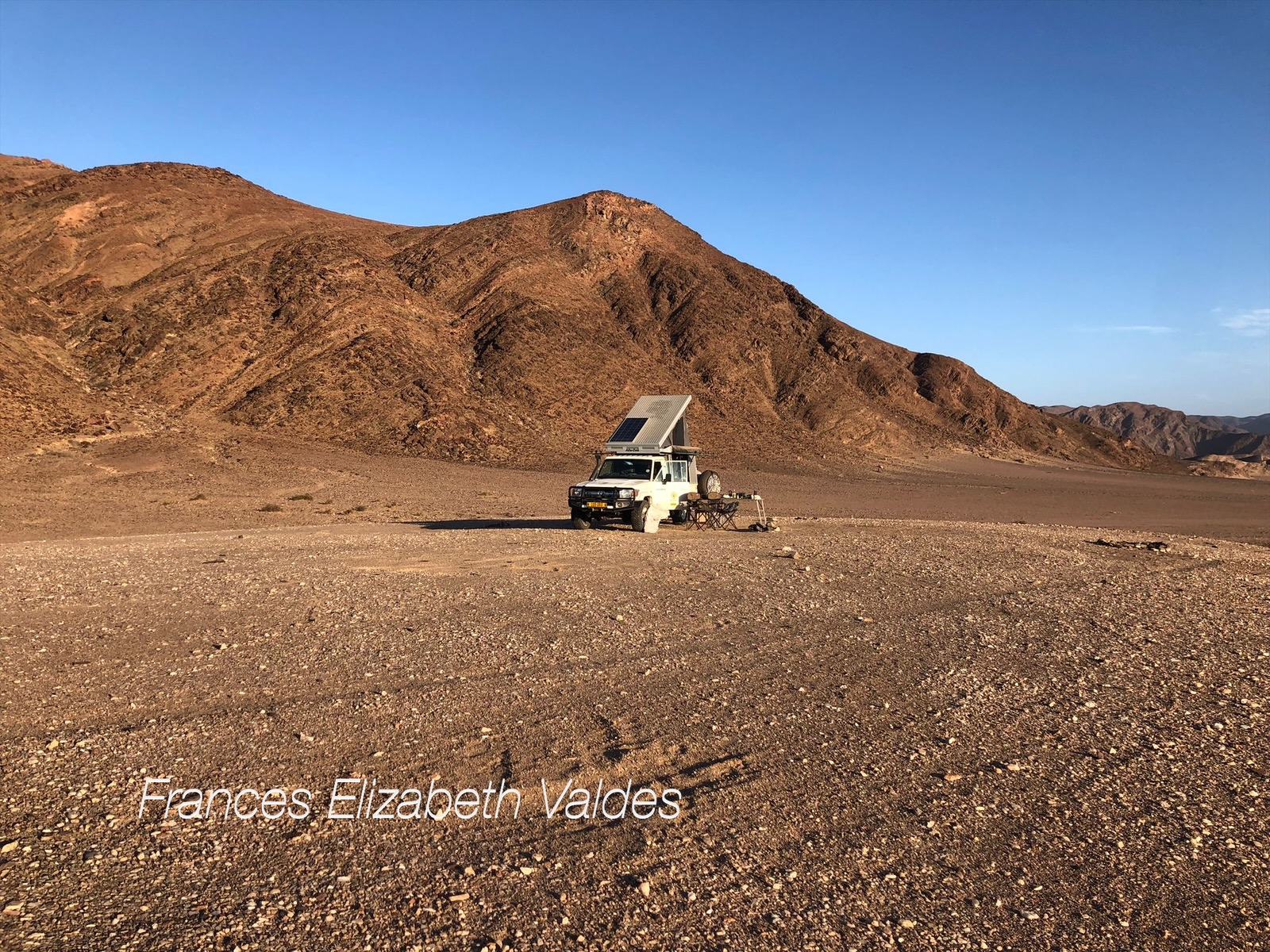
Mudorib – Hoanib – Elephant Song
I was excited to be back in the Hoanib Valley, which was a place we had only spent a couple of days in before. I really wanted to spend longer in the area this year. We weren’t certain how long because we were still, at this point, intending to go to the north-east to the Khaudum Park and Caprivi Strip. However, after spending a day or two in Hoanib, this also changed!
We had been told that Hoanib was in flood, and there were signs of recent flooding further to the east in the valley, but there was nothing around the President’s Waterhole. I have no idea why it is called the President’s waterhole. When we were back home I tried to find out, but couldn’t. There is a ranger station there, but no-one was living in it. In fact, it looked abandoned. In 2020 there had been rangers there, and we’d got some shopping for them when we went into Sesfontein (a long drive up the valley).

The waterhole is supplied by a pump much favoured by the elephants. Elephants like fresh water. So, being clever, they work out where the waterhole is being filled from, and pull up the hoses pumping the fresh water from the borehole into the waterhole.
This means there is a never ending battle to outsmart the elephants and protect the waterhole pump.
In 2020 we filled up our camper from the pump at the waterhole, and then had a glorious shower in the midday sun. When we had arrived at the waterhole on that occasion, the pump wasn’t working, but Nigel fixed it. We learned later that the rangers had sent for maintenance people, a day’s journey away, to mend the pump Nigel mended in a few minutes.
The pump had a new wall built around it to try and make it even more elephant proof. It clearly worked as even Nigel had difficulty making his way through the entrance. He was slow, because he couldn’t see what was inside. That’s a thing in the African bush – if you can’t see where you’re going, you’ve no idea if something higher up the food chain is already there.
The new improved water pump did not allow us to fill up our water tanks. We weren’t sure if we were going to a wild camp that night, but this made up our mind. We would drive up the Hoanib, and camp at the bush camp with showers at the other end.
We spent the day slowly driving up the valley. It is a beautiful part of Namibia. The river may be ephemeral, and the ground sandy, but there is underground water allowing bushes and trees to flourish.
The buses and trees provide just enough nourishment for springbok and oryx; which provide just enough food for lions. And wandering among the beauty are the kings – desert elephants.
It is one of the few parts of the world where desert elephants can be found. To be pedantic these are desert adapted elephants, not desert elephants. They are not a separate species, but have adapted to their environment with larger feet, longer trunks, and are usually slightly smaller than their standard African counterparts.
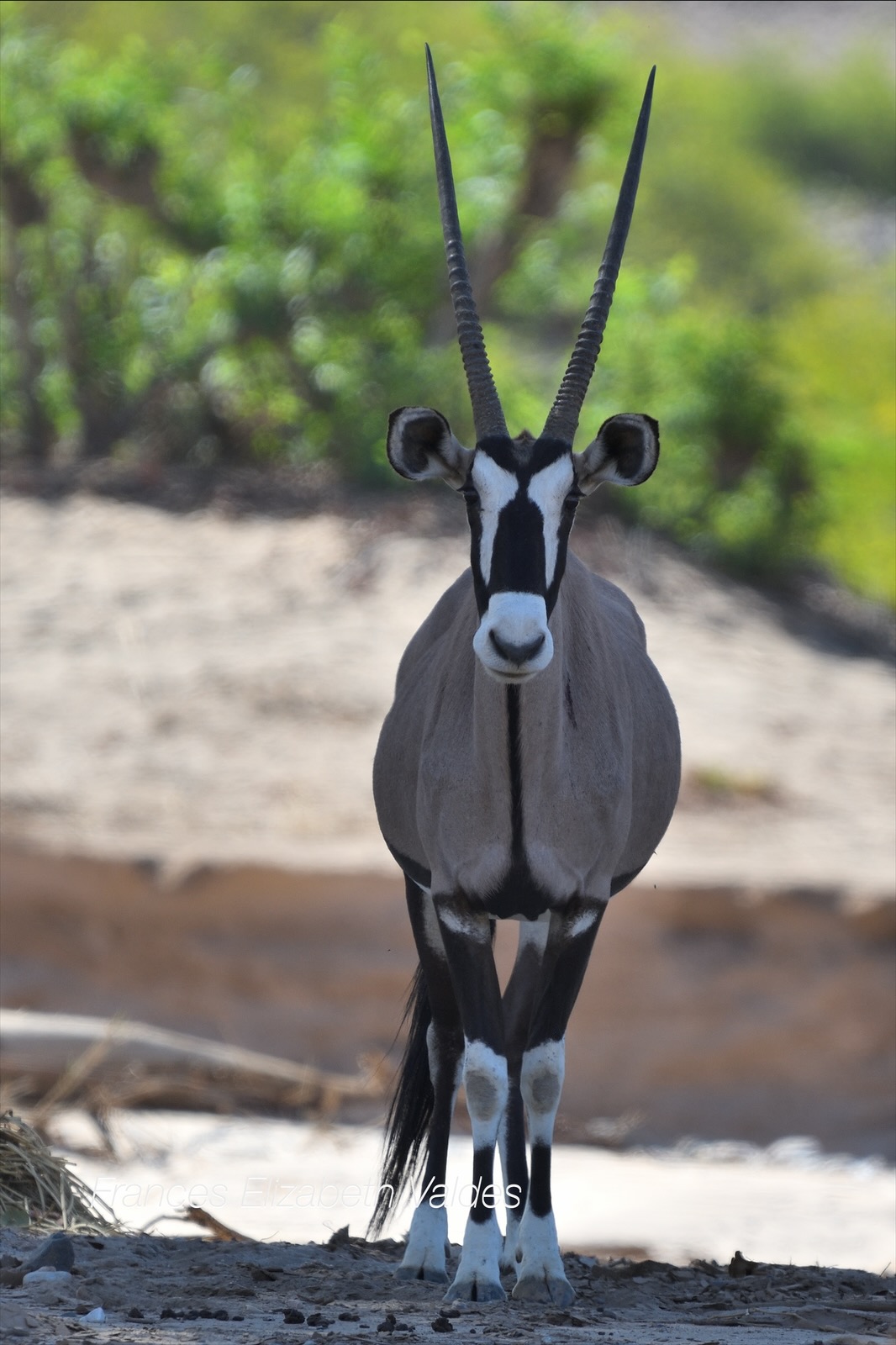
Driving up the river we only saw one bull elephant, which was a bit of a disappointment. It seemed to us that everywhere had less animals than previous years. There was evidence of recent rain. Bushes seemed greener, and there were faint signs of new grass in some areas. But the rain had obviously been brief.

Further along the river there was a sign of recent flooding. We saw a car track going off into mud and stopping. Nigel got out to see if things had dried enough for us to follow the track, but they hadn’t. We made a detour, ploughing our way through the scrub. Over subsequent days, this became the new route, which is why Track4Africa isn’t always up to date.
We came to the end of the river in the early afternoon, and saw Elephant Song campsite on the ridge above the river. However, because of the recent flood it wasn’t easy to see how to get to it. The river was very muddy, and what we thought was the track to the camp looked impassable. We drove on, and realised we were going away from the campsite so came back, as we did, we saw the manager Magnus, pointing the route out to us.
We paid for two nights, and told Magnus we had been there in 2020. At that time he said he thought he remembered us, but I thought it was just politeness. A little later he came down to our pitch and said he remembered Nigel. He remembered that Nigel had warned him of an illness that was spreading through the world. At that time Magnus had not heard of Covid. I was amazed that he really remembered Nigel and what he had said. In a way, it must have seemed like a sci-fi movie – a stranger arrives in a desert bush camp and tells of a global pandemic.
Magnus, like so many of the people we spoke to and met, was desperate to improve his lot. He spent 6 weeks at camp and then 2 weeks at his farm. They had mainly kept him on during covid which was nice to hear. Magnus had saved up enough money to pay for a guide’s course, and he’d produced a laminated leaflet offering his services.
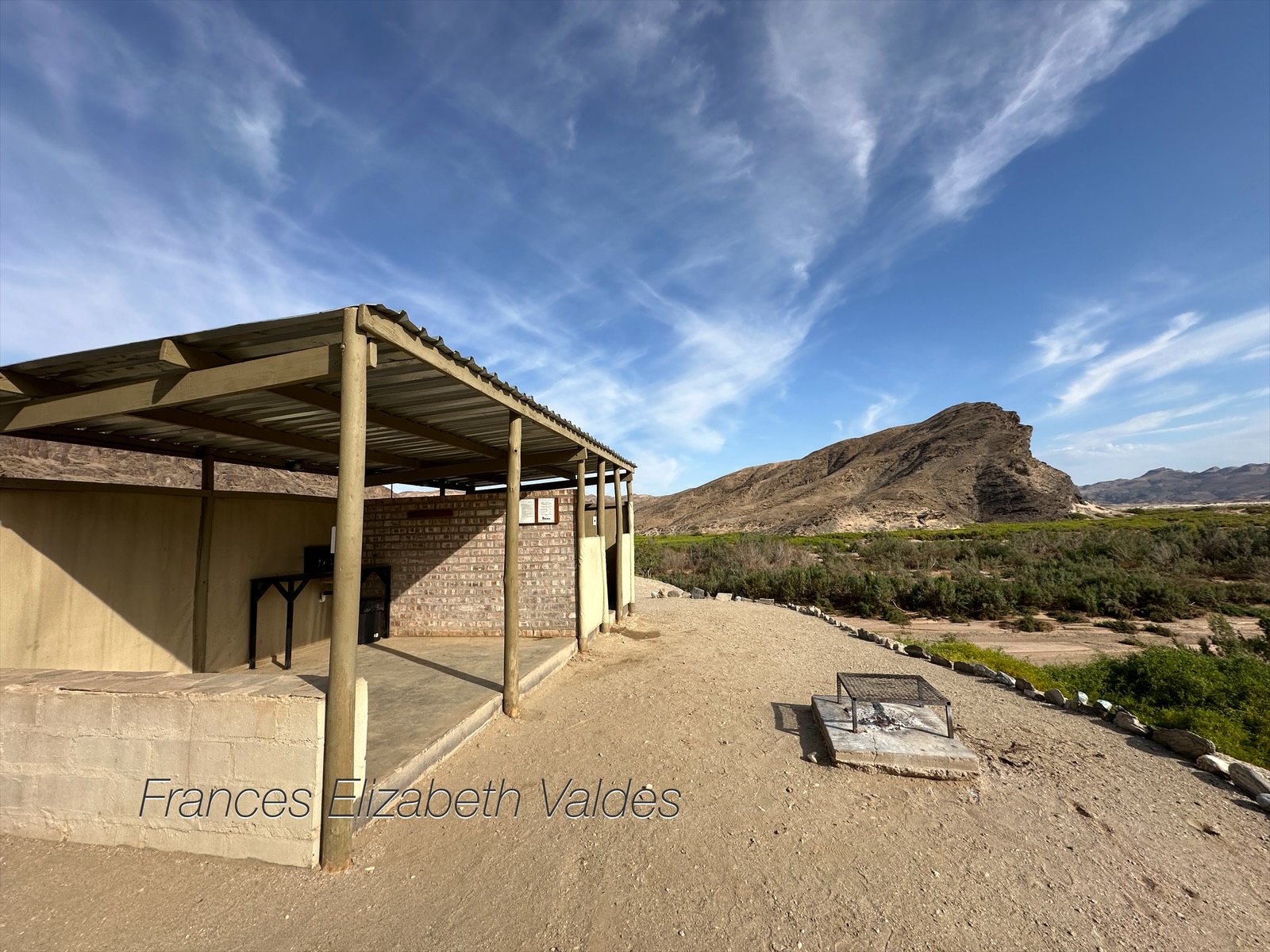
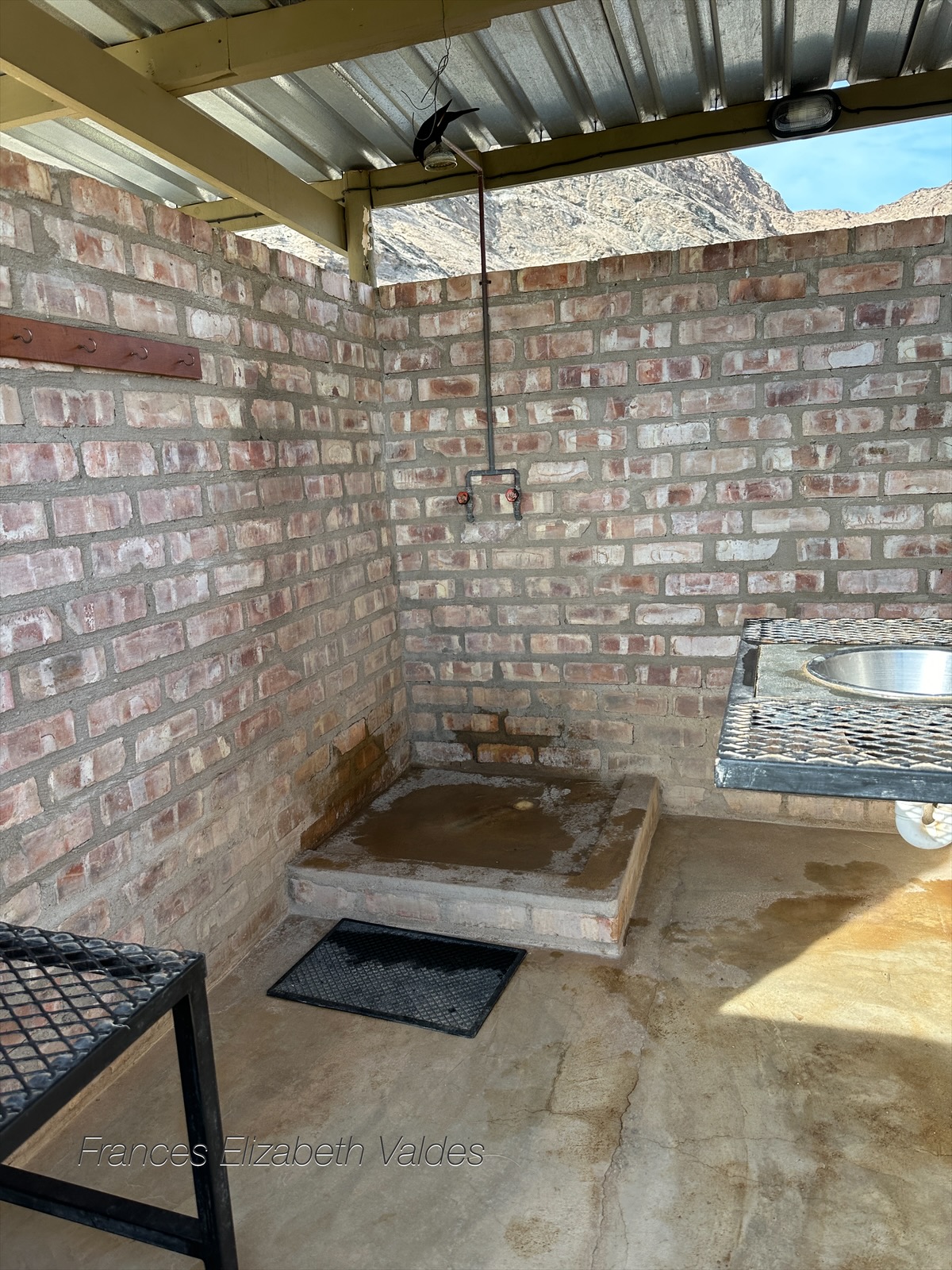
Our favourite pitch at Elephant Song (top), and the extremely welcome shower (right). If you look closely, one of the marauding starlings is trying to drink from drips off the shower head. Our land cruiser had a shower attachment on the outside, and we had a shower every night, but we had to be frugal with the water. Having said that, the drought in Namibia meant we didn’t feel it was right to stand on Elephant Song’s shower for long.
The shade in the campsite was very welcome in the heat of the afternoon. There were only half a dozen pitches, all with lovely open air showers, toilets, and kitchen sink area. There was a fire pit, which proved a little useless in the relentless wind. We sat, sheltering from the wind in the kitchen patio, and looking out to a wonderful view of the Okambonde Plains and the surrounding mountains.
The camp had a satellite dish and wifi within a small area next to Magnus office and living quarters. It was a bit flaky, but enabled us to pick up emails (I wasn’t sure if I wanted this, but when it’s offered there is a compulsion to ‘just look’).

Mid afternoon Magnus came to us and said a family of elephants could just be seen in a clearing to the west of the campsite. We caught a view of three or four adults, and at least two calves before they disappeared into the surrounding bushes. This was Stompie’s and her family, and we would get to know them really well over the coming days.

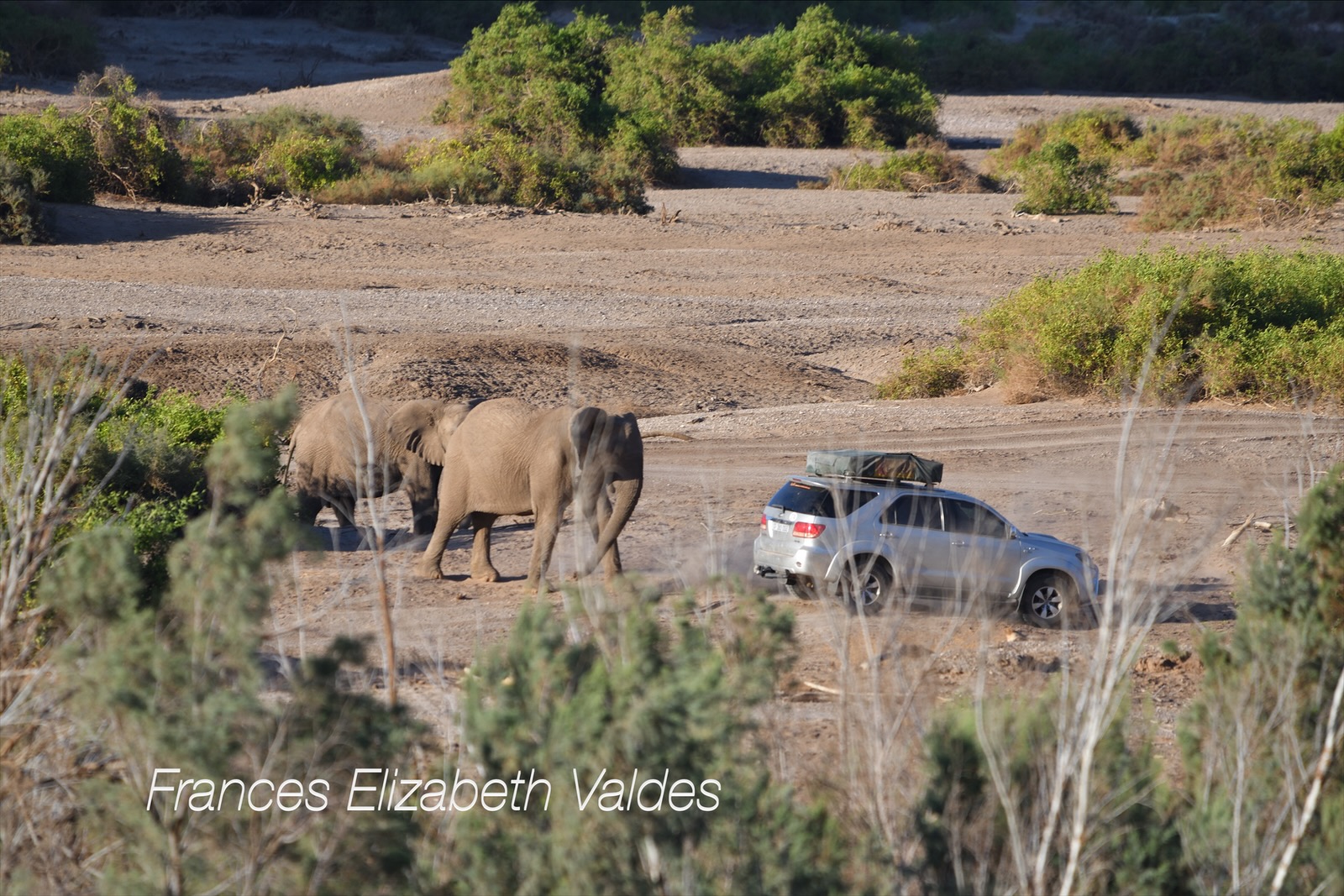
We watched a 4-wheel drive camper drive through the concession gates in the distance, followed by a small 4-wheel drive urban car. This was the great thing about our pitch, the view it gave us of, what little comings and going there were. The two vehicles disappeared west down the Hoanib river. We were fully convinced that the smaller of the cars would not be able to manage. But it did, and we saw them both come back and drive up to the campsite. People in this part of the world are generally camping because they want to be by themselves, so they went to the opposite end of the campsite to us – which was a relief!
Apparently they were desperate to see elephants, but needed to get to Opuwo the next day. Magnus went with them to find the elephant family. They failed and came back, but after about an hour the elephant family reappeared in the plains beneath the campsite. The two vehicles hurried off with Magnus, and we watched them find the elephants, and then get too close and be charged in a fairly half-hearted way by Stompie.

By evening we tried, for the only time we were there, to light a fire. We did but it was almost impossible to cook because of the strong wind.
We did however have a lovely showers. Nigel made the mistake of throwing some bread to the beautiful starlings which walked along the wall of the shower to drink the water. Before he knew it, we were surrounded by a large flock of their friends, and they hounded for the rest of the time we were there.
As much as I love wild camping, it was quite nice to be in a campsite, with decent showers and sitting up after dark. One of the problems of wild camping is the thought that you are fairly low down on the food chain when it gets dark. Nigel had some motion detectors which he puts out, but we’re still not confident, so we were always in bed once it gets dark. In a campsite that isn’t necessary.
 Desert Wonderers